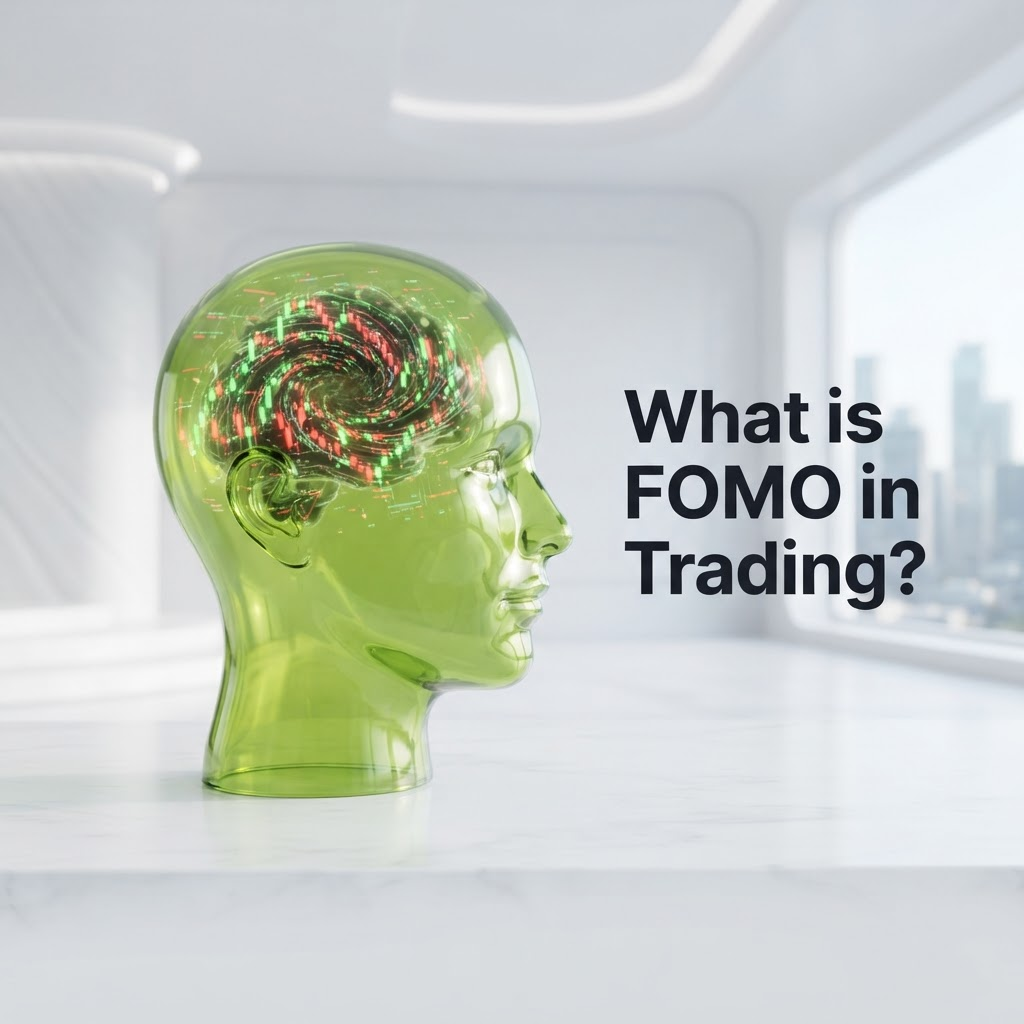
What FOMO Actually Is (And Why Your Brain Creates It)
FOMO in trading is the anxious impulse to enter a trade because price is moving without you. You see a candle exploding upward, your feed is full of profit screenshots, and a voice in your head screams "get in now before it's too late." That voice is not analysis — it is a primal loss-aversion mechanism misfiring in a financial context.
Neurologically, watching a move happen without you activates the same circuits as physical loss. Your brain treats the unrealised gain of others as your personal loss, generating urgency that overrides your trading plan. This is why even experienced traders feel FOMO — it is biology, not weakness.
The market exploits this ruthlessly. The moment a move looks "obvious" and safe to chase is statistically the moment it is most likely to reverse. FOMO entries are systematically the worst-priced entries available, which is why chronic FOMO traders lose even when their directional bias is correct.
How FOMO Destroys Prop Firm Accounts Specifically
In a prop firm environment, FOMO is uniquely dangerous because of drawdown limits. A personal account can survive a reckless chase and recover over months. A funded account with a 5% daily drawdown limit cannot — one FOMO-driven oversized entry during a news spike can end the account in minutes.
FOMO also compounds. A missed move creates frustration; frustration creates a chase; the chase creates a loss; the loss creates revenge trading. This cascade — from a single skipped setup to a breached account — routinely happens within a single session. Recognising the cascade early is the skill that saves accounts.
The evaluation clock intensifies everything. Traders behind on their profit target with days remaining feel institutional-grade FOMO on every candle. This is precisely when the ten strategies below matter most.
Strategies 1–5: Structural Defenses Against FOMO
The most reliable FOMO defenses are structural — rules and systems that remove the decision from your emotional brain entirely.
- 1. Trade from a pre-written watchlist only: if the instrument was not on your morning list, you cannot trade it today — no exceptions
- 2. Use limit orders instead of market orders: define your entry level in advance and let price come to you; if it never comes, there was no trade
- 3. Cap your daily trade count at 2–3: scarcity forces selectivity, and selectivity kills chasing
- 4. Set a "candle close" rule: you may only enter after a full candle closes confirming your setup — never mid-candle on impulse
- 5. Remove profit-porn from your feeds: mute the screenshot accounts; their wins are marketing, and they are triggering your losses
Write your watchlist and entry levels BEFORE the session opens, when you are calm. Your pre-market self is a better trader than your mid-session self will ever be.
Strategies 6–10: Psychological Rewiring
Structure handles most FOMO, but lasting freedom requires rewiring how you relate to missed moves.
- 6. Reframe missed moves as data, not loss: a move you missed cost you nothing — log it, study it, and note whether your system would have caught it
- 7. Keep a "FOMO journal": every time you feel the urge to chase, write it down instead of acting; review weekly and watch how often chasing would have lost
- 8. Adopt the "infinite trades" mindset: the market produces thousands of setups per year; missing one is missing 0.03% of your opportunities
- 9. Practice the 15-minute pause: when urgency spikes, walk away from the screen for 15 minutes — if the setup is real, it will still be valid
- 10. Measure yourself on process, not profit: grade each day on rule adherence; a red day with perfect discipline is a win, a green day of chasing is a loss
The FOMO-Proof Trading Routine
Combine the strategies above into a daily routine: pre-market planning (watchlist, levels, news check), a defined trading window (for Indian traders, the London–New York overlap from 1:30 PM to 7:30 PM IST offers the best liquidity), limit-order execution, and a post-session journal review.
Traders who follow this routine report that FOMO does not disappear — it becomes irrelevant. The feeling still arises, but there is no decision left for it to hijack, because every decision was made before the emotion existed.
This is exactly the psychological profile prop firms fund. At The People Prop, the traders earning consistent bi-weekly payouts are not the most brilliant analysts — they are the most structurally disciplined. Build the routine, and the payouts follow.
For your next 20 trading sessions, grade yourself daily from A to F purely on rule adherence. Traders who sustain an A average for a month almost never fail evaluations.